
How to Build an Online Business Without Anyone You Know Finding Out
You want to build an income online. But the thought of someone you know stumbling on it before you're any good freezes you up.
You don't need to disappear to fix that. Shielding is how you get good in the dark, before anyone's watching.
Building online means creating income that doesn't depend on the 9-to-5, by becoming the voice people follow before they buy. 86% of consumers make at least one purchase a year on a content creator's recommendation. Not an ad. A person.
It's Not Fear of Failure
It's fear of being judged by people who matter to you before your project has taken shape.
Your first low-quality videos. Your clumsy writing. Your half-baked opinions. Strangers' comments visible to your inner circle. That's what you want to keep to yourself.
The People You'd Rather Avoid
Family members. Coworkers. Your boss. Professional clients.
The people who might discover your work before you're ready have a name: nightmare readers.
Why Everyone Sees Everything at Once
The mechanism that makes shielding necessary is called context collapse: the merging of all your separate audiences — family, friends, coworkers, acquaintances — into one single crowd the moment you post something online.
In real life, you don't have the same conversation with your family that you'd have with friends on a Friday night. Your brain makes that distinction effortlessly.
Online, that separation disappears. One post, and everyone ends up in the same room, listening to you at once.
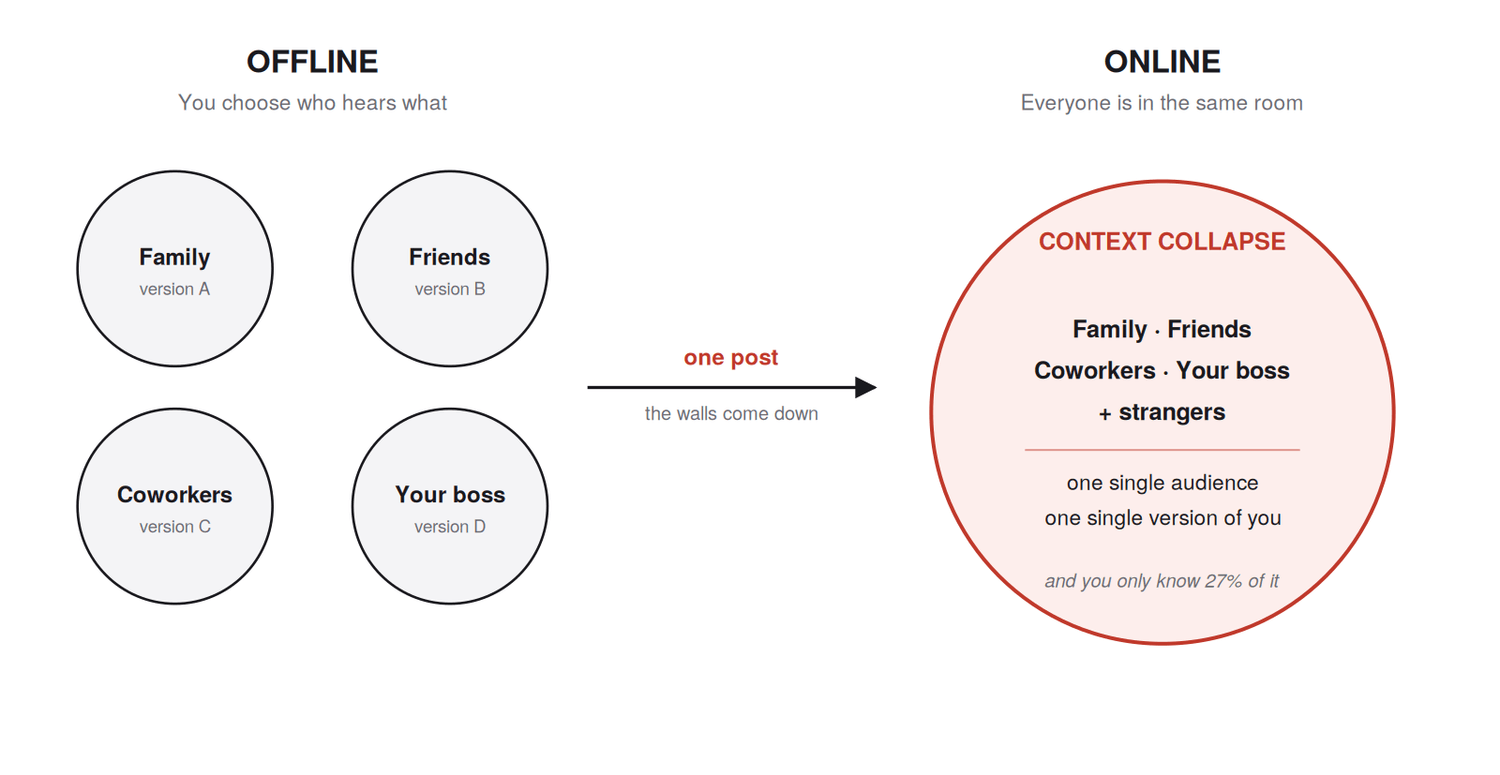
Studies say we only know about 27% of our actual audience — meaning nearly 4 times more people see what we post than we think. Shielding doesn't just filter what your inner circle sees. It also makes sure your activity doesn't get discovered by the wrong people, at the wrong time.
Nobody would sing karaoke in the middle of a work meeting. That's the problem with social media: everyone sees everything, all at once, when nobody actually needs to see it all, all the time.
Researchers studied how young adults, freshly out of their parents' house, handled this exact situation. Their solution: one account for family, coworkers, and friends — another for their professional pursuits.
Shielding is simply that.
There's nothing sneaky about it. It's exactly what you already do when you don't tell everyone you know the same version of last night. Shielding is building your business in a silo, without consequences for the people around you.
The starting point is never to disappear. It's to choose who sees what, instead of leaving it up to chance.
Building Effective Shielding
It starts with a new email. That's what creates your first separate social media account.
Instagram, TikTok, YouTube, LinkedIn — the choice depends on your activity and the scope of your project. None of these platforms is essential on its own. What matters is remembering that each one is tied to your new public identity, not your personal profile.
This identity doesn't need to be fake, just distinct. Researchers call this pseudonymity, different from pure anonymity.
The trap is unconsciously repeating the details that connect both versions of you:
Your address
Your birthplace
Your birthdate
Your home country
Even your phone number — keep it to yourself. It's yours alone, nobody needs it to follow you online.
Every detail you don't hide is one more chance someone puts the pieces together. And unlike full anonymity, pseudonymity still lets you build a solid reputation: a name people recognize and follow, just not your own.
Then there's the audience itself. You start from zero: a fresh public that discovers you for what you do, not who you are. One account, or several interconnected ones around the same activity, but completely detached from your personal identity.
Never ask your friends to follow your new account
The temptation, early on, is to reach for that easy boost. Resist it.
Beyond the risk of identity crossover, social media algorithms will show your content to people who resemble your first followers. If those are your friends, it's not your potential customers the algorithm goes on to recommend — it's more people just like your friends.
You sabotage your new digital profile before it even gets started.
No early contamination. It's one of the most important rules, and the one most often broken, when building a new separate identity.
Sources
Marwick, A. & boyd, d. (2011). I Tweet Honestly, I Tweet Passionately: Twitter Users, Context Collapse, and the Imagined Audience. New Media & Society, 13(1), 114-133.
Bernstein, M. S., Bakshy, E., Burke, M., Karrer, B. (2013). Quantifying the Invisible Audience in Social Networks. Stanford University / Facebook Data Science, CHI 2013.
Nitschinsk, L., Tobin, S. J., Varley, D., Vanman, E. J. (2025). Why Do People Sometimes Wear an Anonymous Mask? SAGE Open.
I'm showing how to build an online business, incognito.
If that's your thing, subscribe below — I send what works, what doesn't, and what I'd do differently.
PARTAGER


Subscribe
What works, what doesn't, and what I'd do differently,
sent to your inbox.
Créé avec ©systeme.io• Politique de confidentialité • Mentions légales